
Dementia, if my love could kill
How my father forgot himself, and how that made the system forget him.
Our father Klaas was a proud man. This is the story of his decline into dementia, of his journey into a world that was no longer his. But it is also about our powerlessness to enforce a respectful treatment of him by the people responsible for his care. We eventually had to accept that he was slowly losing himself. How he had to spend his final days, however, is something we still cannot accept.
The original Klaas rarely doubted himself, at least not openly. His version of reality was his absolute guideline for life. He was a socially engaged pacifist, a progressive man, and as a father, larger than anything around us. He knew everything. We had complete freedom to go our own way. Klaas did the same.
His principles were more important than what others thought of them. That could hurt, but his motives were pure, at least in his own perception. According to Klaas, you could solve anything by talking about it. Our father could do that; he had a great talent for talking, lots of talking. He felt that the fact that this didn't always go down well with everyone wasn't his fault. In that sense he was completely predictable in everything he said. It was difficult to be angry with him. And even more difficult to stay angry.
When our mother Leni suffered a stroke in 2010, he took over her care completely. That wasn't entirely altruistic: he wanted to help her recover, but he also wanted to reclaim his freedom, to be important, to make a difference. After her passing in August 2017, he was left devastated. Without her, he was incomplete, unimportant, empty. He withdrew to his apartment and openly doubted his will to live without her. His isolation took its toll, but he managed to hide his decline well. Everyone was shown a different Klaas, a Klaas who mirrored what people wanted him to be. A Klaas of fragments. Because of this, it took a long time before all of us saw that there was more going on than just grief.
Following a stroke in 2019, these problems became more apparent. At the start of the COVID-19 period, we found him severely ill in a neglected house and a dirty bed. He refused to go to hospital. When the family doctor explained that he would likely die at home, he accepted it. He wanted to go to Leni. Miraculously, he recovered. But the man who lay watching television on the couch under a blanket was less and less our father. His days were long. His nights filled with terrifying dreams and hallucinations. Klaas had always said he wanted to check out when he became "that old man standing by the street who no longer knew where he was going." When he left his apartment at night and got lost, he had passed that point.
We had his living will, but he could no longer tell anyone why and how it should be implemented. In April 2023, he was admitted to a closed ward at "Het Koetshuis". After many discussions with us, he made the transition "voluntarily," but losing his freedom didn't feel voluntary to him at all. He resisted, sometimes aggressively. When I was called because the staaf didn't know how to handle him, he usually no longer even remembered what had happened. "Me? Aggressive? What do you mean, when?" His anger toward us slowly faded as well. Just as Klaas slowly faded into a world of fog and uncertainty.
In the ward, he struck up a relationship with a woman. The staff tried to keep them apart, sometimes using force. Our objections were met with arguments about safety and impropriety. Eventually, it turned out that her daughter didn't want the relationship. For "Het Koetshuis", that was an insurmountable obstacle. Klaas was transferred, and a very painful sign of his dementia was that he quite quickly no longer remembered she even existed.
In the new ward, he deteriorated rapidly. There was nothing to do for the people living there, and so he spent his days at the living room table, staring blankly ahead. The present vanished. In his mind, he was on the train to Vlaardingen or in church, and he regularly told us about the cheap shoes he had bought in a cave in the Ardennes. Where that story came from, we never understood.
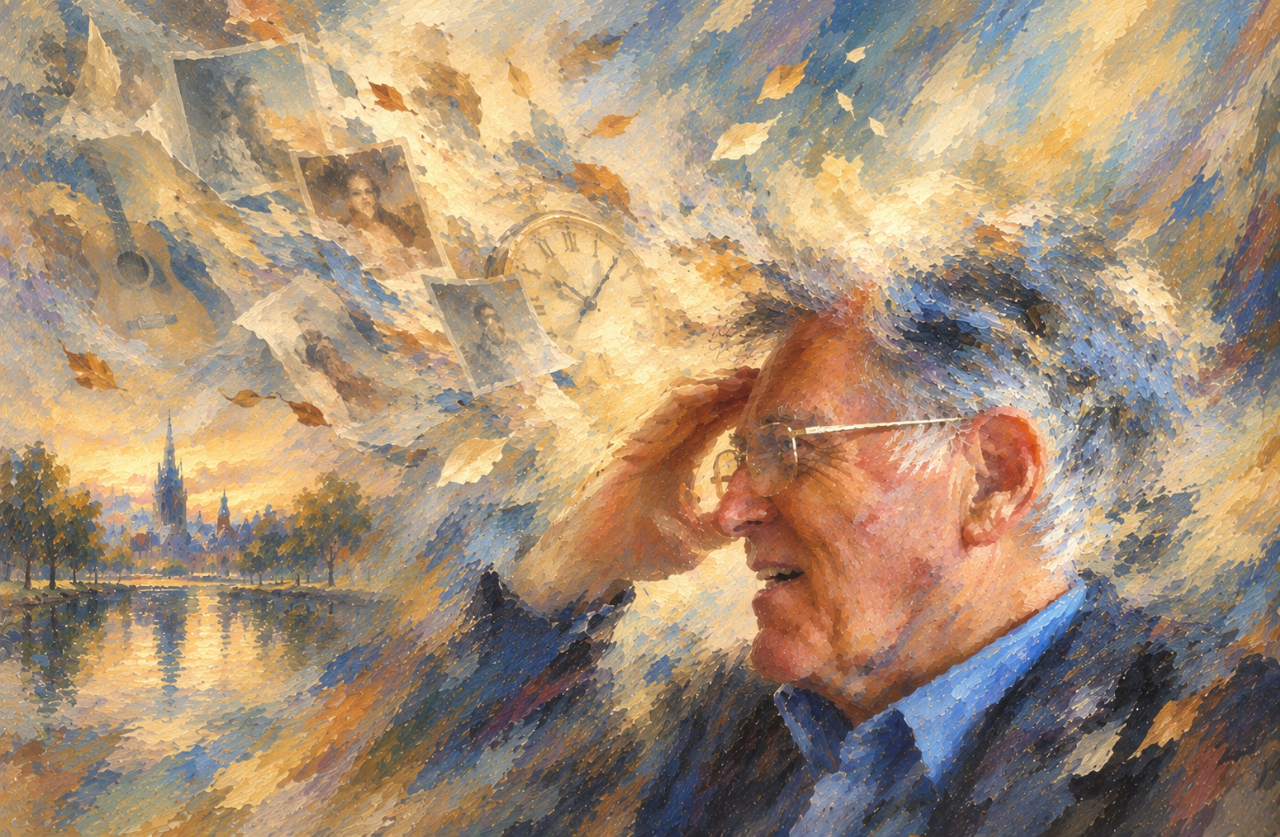
He wanted so badly to understand the world around him. He made desperate efforts to find some order in his chaos, and he was completely devastated when he failed. Every time that happened, a piece of Klaas broke off that he could never find again.
We got along well with the staff, we talked to them and they understood what we felt. With management and the institutional physician however, that became increasingly difficult. Our conversations focused on their rules and procedures, while we were trying to talk about Klaas. His personal supervisor was a trule great guy, but he too was powerless. He tried, but the institution's paper reality gained more and more ground, and Klaas the human was left behind. By now,management didn't know what to do with the situation either. Klaas was difficult. We were difficult. In conversations, there was invariably talk about the "difference in level" between us and the nursing staff. Painful, because that was never the problem, because in terms of care and love, their level compared quite well to ours.
Whenever we brought up the existence of his living will with management, the conversation came to a halt. One time, the institutional physician accused me of simply wanting him dead because that "would be easy." That accusation came back later, when our only remaining question was how his pain and panic could be relieved. For Klaas's health went from bad to worse!
In late July 2025, Klaas developed a urinary tract infection. After painful, unsuccessful attempts to insert a catheter, a procedure followed in the hospital. Afterward, he was exhausted, he was spent in more ways than one. He barely wanted to eat or drink, and he slipped further and further into the background of his consciousness. The end was in sight, and we came to say our goodbyes. Sometimes he would react briefly, open his eyes, or say something. But when he woke up, he was usually in panic. He was in pain and didn't understand what was happening to him. He was given sedatives and morphine. To us, it was visible that these were insufficient. The staff also saw his restlessness, but they were not allowed to give more than had been prescribed, which was not sufficient to take away his pain and restlessness. The discussions with management became more intense. According to the doctor, there was "no question of futile suffering yet." More medication would amount to palliative sedation, and Het Koetshuis was unwilling to help Klaas with that. Meanwhile, Klaas had stopped drinking, and even a touch became painful. His breathing faltered. Sometimes we thought it was over, but then he started breathing again. The visit became a death watch. Eventually, the medication was increased to the point where he rarely woke up. He was given just enough to lose touch with what was going on around him, but too little to offer him a way out. What he could still perceive, we no longer knew. His eyes and mouth looked terrible, Klaas looked terrible. And still it wasn't enough.
On August 12, 2025, Klaas passed away. His death was a horrible prolonged process, brought to him by the people who should have prevented this from happening, and which left him stripped of everything that made him Klaas. Afterwards, management at Het Koetshuis apologized for what happened to Klaas, and blamed all the arguments about whether or not he was given enough sedatives on a misinterpretation of the instructions given by the staff, a blatant lie. Whatever, no retrospective conversation and no excuse can undo what they did to him.
Looking back is difficult. Dementia is a terrible process. You watch someone disappear while they are still sitting across from you. But denying a person a dignified end adds something to that which does not belong to the disease. Klaas was a proud man. When he could no longer protect himself, his dignity became the responsibility of the people who took over the responsibility for his life. Those people let him down!
Dementia is more than forgetting yourself, it also impact all the people who are connected to the person suffering from it.For Klaas, dementia also meant having to live in a system that forgets who you were, who you are. A system in which rules are more important than the people those rules are supposed to protect.
Our memories of our father differ. About his final days, we all agree. That, too, says something. Klaas passed away on the exact date his Leni had been buried years earlier.
Could he have been waiting, could she?
If my love could kill
I would kill this
Destroyer of brilliance
Destroyer of hope
Invader of skin
Invader of bone
Who robbed me of your memory
Who robbed me of your time
Made her way into the symphony
Of your beautiful mind
Lucinda Williams